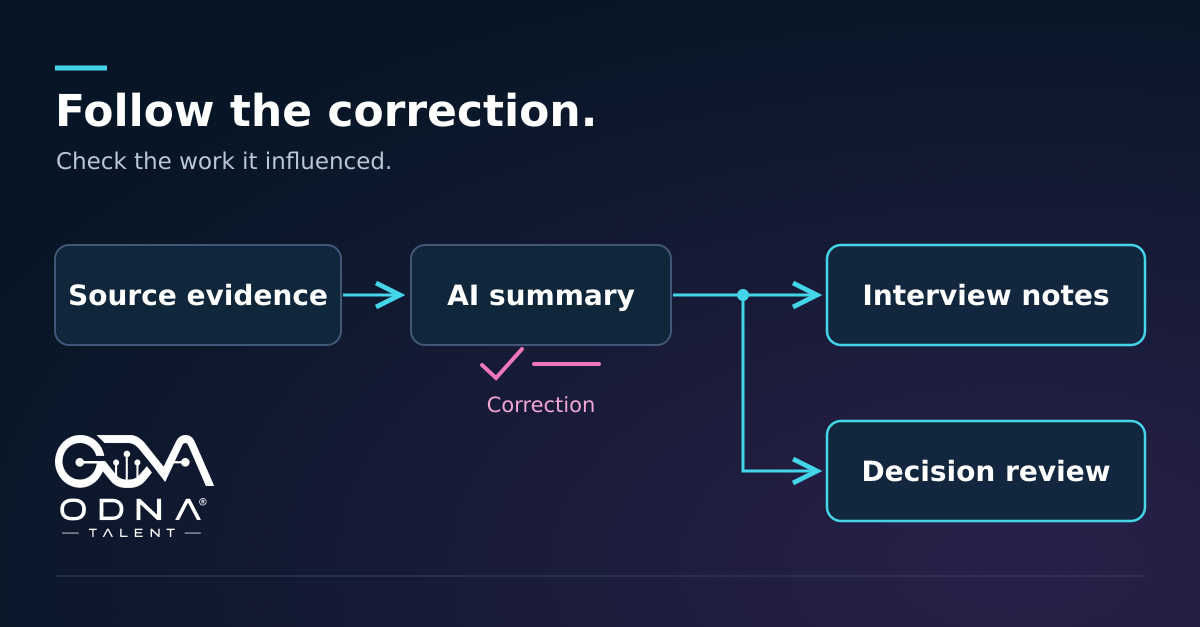
Correcting a sentence is not the same as correcting a hiring process.
If an inaccurate AI summary has already shaped interview questions, comparison notes, or a manager's recommendation, replacing that summary leaves another question unanswered.
Who used the original information, and what did it influence?
That is where human review needs to become specific. Find the error. Establish the correct information. Check the work that relied on it.
Why this deserves attention now
On November 2, 2026, NIST released a report on its incident-management workshop. The announcement identifies evidence collection, information sharing, and clearer responsibilities among developers, deployers, and users as areas for further work. [1]
The report concerns broader super-intelligence incident management. It is not a hiring standard, a study of ODNA Talent, or proof that an ordinary summary error is a major security incident.
My practical application is narrower: a hiring team should know how to respond when information it relied on turns out to be wrong.
Start with the source, not another generated answer
Suppose a summary says the candidate independently managed a process. The underlying interview notes say the candidate assisted the person responsible for that process.
Before asking AI to rewrite the paragraph, confirm what the source actually supports. Which document contains the original account? Is it the correct candidate's record? Is it the version the reviewer intended to use?
Then separate three possibilities:
- The source information was wrong.
- The summary misrepresented accurate source information.
- The reviewer interpreted an accurate summary incorrectly.
Those problems call for different corrections. Do not assume that regenerating text fixes all three.
Pause reliance on the affected information
My recommendation is to mark the disputed material clearly and keep it out of the next decision until an authorized person has reviewed it.
Keep the response proportionate. An isolated wording error may require a limited correction. Mixed candidate records or unauthorized disclosure may require a broader review by the appropriate HR, privacy, security, or legal personnel.
Preserve the original and corrected versions through the organization's approved recordkeeping process. Limit access to people who need it. Do not circulate candidate information widely in an attempt to explain the problem.
These are suggested operating practices. Specific retention, notification, and employment obligations require qualified advice for the situation.
Practical use: follow the error through the work
Use one correction record with a named owner. Answer these questions before treating the matter as closed:
| Review question | Evidence to record |
|---|---|
| What was wrong? | The disputed statement and the verified source |
| Where was it used? | Affected summaries, notes, comparisons, and recipients |
| What needs reconsideration? | Questions, ratings, recommendations, or decisions that relied on it |
| Who checked the correction? | Authorized reviewer, review date, and unresolved questions |
| What prevents repetition? | A specific process change and a check that it was applied |
This record can be maintained through the employer's approved process. It is not a claimed ODNA Talent incident-management feature.
Do not record only that a new summary was generated. Record whether the affected people received the correction and whether they reviewed the work that depended on the original.
If a decision had already been communicated, involve the authorized HR decision-maker. Do not improvise a remedy or assume that editing a file reverses the consequences.
A hypothetical example: responsibility overstated
Consider a hiring team evaluating an operations coordinator. This is a hypothetical example involving a generic AI-assisted workflow, not a reported ODNA Talent incident or client story.
A candidate explains that they prepared schedule changes for a supervisor's approval. An AI-generated summary describes the candidate as having final scheduling authority.
A manager copies that description into comparison notes. The error is discovered before the final hiring decision.
The reviewer checks the original account and corrects the description. The correction owner then identifies the comparison notes and tells the manager exactly what changed. The manager revisits any rating that depended on independent decision authority.
The candidate's experience is still relevant. Its scope is now represented accurately. If an important question remains, the team asks a focused follow-up instead of preserving the earlier assumption.
No hiring result, savings, or performance improvement is claimed. The example shows why correction needs to reach the affected review, not stop at the first document.
What this means for ODNA Talent
ODNA® Talent's published responsible-AI guidance says AI-supported output may be incomplete, inaccurate, outdated, or missing relevant context. Authorized users must review it before relying on it. [2]
The assessment workflow starts with the role. Employers can select an appropriate pre-built assessment or develop a role-specific configuration. For the latter, documented requirements, manager input, company criteria, and the optional ODNA® Role Blueprint inform Assessment Architect Mode's recommendations. A person reviews and approves the configuration before delivery. Report Analysis Mode supports review of results, and authorized people make the employment decision. [3]
That is not one fixed profile for every job. It is also not permission to treat generated guidance as a substitute for the underlying evidence.
As I wrote in The Great AI Panic:
“The report helps a person think. It does not relieve that person of the responsibility to think.” John P. Beck, Jr. [4]
A reviewer's responsibility includes asking where an identified mistake has already been used.
Close the correction with evidence
My suggested review measures are simple: time from discovery to owner assignment, affected items still awaiting review, and repeated errors with the same apparent cause.
These measures show whether the correction process is being completed. They do not establish hiring quality, prove legal compliance, or show that a tool caused a workforce outcome.
Test the process before it is needed. Give the hiring team a synthetic example with an intentional mismatch between source notes and a summary. Ask them to identify the source, find affected documents, and explain who can approve the correction. Keep real candidate information out of the exercise.
The useful question is not just whether someone spotted the error.
It is whether the team corrected the information and reviewed what it influenced.
Practical takeaways
Practical takeaways
- Verify the underlying source before rewriting the output.
- Distinguish source errors, summary errors, and interpretation errors.
- Stop reliance on affected information while it is reviewed.
- Check downstream notes and decisions, not only the first document.
- Give one authorized owner responsibility for confirming completion.
Sources and verification
- 1. NIST: Workshop on SI Incident Management, announcement, November 2, 2026
- NIST: Official report record
- 2. ODNA Talent: Responsible AI and Data Protection
- 3. ODNA Talent: How It Works
- 4. John P. Beck, Jr.: The Great AI Panic
The practical checklist, correction measures, synthetic rehearsal, and hypothetical example are recommendations, not reported research results. No scientific coefficients, legal guarantees, client outcomes, or unverified scale names are included. No competing assessment or recruiting provider is used as an authority.