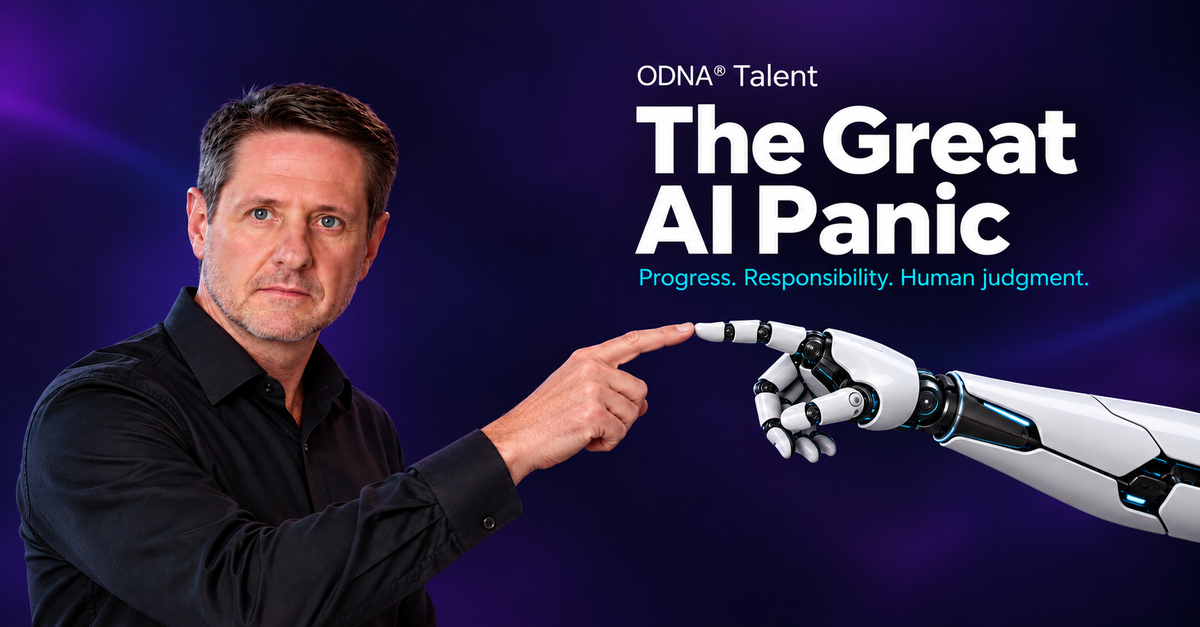
The phrase “AI is building AI” sounds like the opening scene of a science-fiction movie.
It also leaves out the most important word: people.
People are using AI to help build better AI. Developers use existing models to write code, prepare data, test results, and recommend improvements, often faster than they could complete the work manually.
That does not mean a machine woke up one morning and decided to create a more powerful version of itself.
People establish the objectives, set access limits, define success, and authorize deployment.
AI may do part of the work. Responsibility remains with people.
“AI can shorten the distance between a question and an answer. It cannot carry the responsibility for what an employer does with that answer.”John P. Beck, Jr.
I Am Not Watching This from the Sidelines
I have spent 31 years working with employee assessments and workforce decisions. I began using modern generative AI when it became broadly available to the public.
I did not approach it as a spectator. I started using it, testing it, challenging its answers, and learning where it could produce real business value.
That experience became part of building ODNA® Talent, an AI company focused on helping employers make better workforce decisions.
Practical knowledge means understanding what AI can do, recognizing where it can fail, and establishing controls before putting it to work. Neither an impressive demonstration nor a frightening prediction should replace that work.
What “AI Building AI” Actually Means
AI can propose and test code, organize training information, and compare model results. One model can also help evaluate another.
Google DeepMind’s AlphaEvolve provides a practical example. The system uses AI models to propose computer programs and automated evaluators to test them. Google reports that one improvement accelerated an important operation in Gemini’s architecture by 23 percent and reduced overall training time by 1 percent.
That is impressive. It is not independent machine control.
AlphaEvolve operates within an engineering process: models propose programs, and automated evaluators test them against defined criteria. Google reports deploying resulting improvements across its computing systems. Google DeepMind explains the process here.
We Have Seen This Pattern Before
Electricity brought legitimate concerns. Early electrical systems could be dangerous. Poor wiring caused fires, service was unreliable, and common safety standards had not yet been established.
The answer was not to abandon electricity.
We improved wiring practices and established safety requirements and electrical codes. The Smithsonian documents those early hazards and the standards developed in response. That history is available here.
The internet followed a similar path.
It gave us immediate communication, global commerce, access to information, and entirely new industries. It also gave criminals new ways to commit fraud, steal information, invade privacy, and distribute harmful material.
We did not shut down the internet because people could misuse it. We developed security systems, privacy controls, authentication requirements, and laws addressing criminal behavior.
A tool can create enormous value and still be misused. Both things can be true.
The comparison has limits. AI can produce convincing but inaccurate answers and carry errors into decisions about people. Its risks deserve scrutiny specific to the task, not reassurance based on history alone.
Human Resources Is Where Responsibility Becomes Personal
The AI discussion changes when we bring it into Human Resources.
An error in a routine administrative task may create an inconvenience. An error involving hiring, promotion, compensation, termination, safety, or leadership can affect a person’s career and an organization’s performance.
AI can help an HR leader organize information, compare evidence, prepare questions, and recognize gaps in a decision process.
It should not be allowed to make an unsupported employment decision.
The Equal Employment Opportunity Commission has made clear that employment laws still apply when employers use AI and other automated technologies. AI can offer benefits, but its use in hiring and other employment decisions can also create discrimination risks. The EEOC explains its role here.
Using technology does not transfer responsibility away from the employer.
Two Modes. Human Responsibility in Both.
At ODNA® Talent, ask ODNA has two modes: Assessment Architect Mode and Report Analysis Mode. Each supports a different part of the work. Human review and approval remain essential in both.
Assessment Architect Mode
The process begins with the job. Before evaluating a person, we need a clear understanding of what successful performance requires.
An ODNA® Role Blueprint documents the role requirements. In Assessment Architect Mode, ask ODNA helps authorized users organize that information and recommend relevant assessment scales, with a rationale for what belongs in the assessment.
A person reviews those recommendations, checks them against the actual work, and approves or revises the assessment direction before the assessment is built and delivered.
We begin with the role and define the evidence the organization needs.
Report Analysis Mode
Once assessment results are available, Report Analysis Mode helps authorized users work with that evidence.
ask ODNA can help summarize assessment reports, compare candidates, prepare executive summaries, develop interview guidance, and support development planning.
The value is in making relevant information easier to review and use. What requires follow-up? Which interview questions would help verify the evidence? What should a manager consider during onboarding or development?
A qualified person checks the output for accuracy, job relevance, fairness, and context. That person may accept it, reject it, modify it, or request additional analysis.
The report helps a person think. It does not relieve that person of the responsibility to think.
Human Review Is Part of the Process
ODNA Talent and ask ODNA do not make final decisions concerning hiring, promotion, termination, compensation, safety, leadership, development, or other workforce matters. Final responsibility remains with the organization using the platform.
AI-supported output can be incomplete, inaccurate, outdated, or missing important organizational and human context. That is why authorized users must review it for accuracy, relevance, fairness, and practical fit. ODNA Talent’s responsible-AI standards are published here.
The National Institute of Standards and Technology recommends clearly defined human responsibilities, documented oversight, ongoing evaluation, and executive accountability for AI systems. The NIST framework provides that structure.
The Real AI Risk
AI can produce confident but inaccurate answers, repeat problems in its data, or receive access it should not have. People can rely on its recommendations without checking them.
For employers, a practical place to start is the organization’s own process: clear objectives, adequate testing, restricted permissions, human review, and accountability.
Skipping those controls is a management failure.
The solution is responsible use:
- Know what the system is supposed to do.
- Know what information it can access.
- Require human approval before consequential decisions.
- Test the output.
- Document the process.
- Make accountability clear.
Progress and Responsibility Belong Together
AI will continue to improve. Some of that improvement will come from people using AI to help develop newer AI systems.
That should not automatically frighten us. It should make us more disciplined.
AI can help employers save time, improve consistency, and ask better questions. Those benefits are worth pursuing with clear controls and realistic expectations.
Electricity was not the enemy. The internet was not the enemy. AI is not the enemy.
Irresponsible use is the risk. Responsible human direction is the answer.
Responsible business AI
Put clear boundaries around the work.
- Define what the AI system is supposed to do and what information it can access.
- Use Assessment Architect Mode for role and assessment design, and Report Analysis Mode for assessment findings.
- Require human approval before consequential workforce decisions.
- Test the output, document the process, and make accountability clear.
Sources and responsible-AI guidance
- Google DeepMind: AlphaEvolve and AI development
- Smithsonian: Early electrification and wiring safety
- EEOC: AI and employment discrimination
- NIST: AI risk management and human-AI interaction
- ODNA Talent: Responsible AI
Educational information only. Organizations remain responsible for obtaining appropriate legal, scientific, privacy, accessibility, and professional guidance.