
A candidate can meet the requirements and still accept the wrong job.
The assessment may be appropriate. The interview may be thorough. But if the candidate expects a regular daytime schedule and the position requires changing evening shifts, the hiring process has left an important question unanswered.
Does this person understand the job they are accepting?
That question deserves attention as holiday hiring continues. In its October 15, 2026 forecast, the National Retail Federation projected 325,000 to 375,000 seasonal retail hires. That is a forecast, not a count of completed hires. It also does not explain why any individual employee stays or leaves. It does give employers a timely reason to check the information candidates receive. [1]
My recommendation is simple: review what the employer has promised before asking the candidate to commit.
A preview answers a different question
The U.S. Office of Personnel Management describes a realistic job preview as a way to explain favorable and difficult aspects of a position. It distinguishes candidate self-evaluation from traditional selection. Its guidance recommends providing the preview before an offer when possible. This is existing federal guidance, not a new rule for private employers. [2]
An assessment helps the employer examine relevant characteristics. A preview gives the candidate information to consider. Keep those purposes clear.
A strong assessment result is not consent to a schedule, travel requirement, or temporary assignment. Those conditions need a direct conversation.
Check the promises, not just the posting
Start with the messages a candidate actually receives. Compare the advertisement, recruiter explanation, manager conversation, and offer materials.
Look for words that need a specific answer.
Does flexible mean the employee can choose hours, or that the employer changes them? Does training provided mean supervised practice with a designated trainer, or access to instructions? Does opportunity for permanent employment describe an approved opening or only a possibility?
These are different commitments. Do not leave the candidate to choose the most favorable interpretation.
For seasonal hiring, explain the expected assignment period and what is known about work afterward. If continued employment is uncertain, say so. A possibility should not be presented as a promise.
Practical use: conduct a promise check
Choose one open position. Put these five questions in front of the recruiter and hiring manager:
1. Which statements could create different expectations? Identify vague language about hours, earnings, training, workload, or advancement. Replace it with information the responsible manager can verify.
2. Who owns the answer? Assign unresolved questions to a named person. Do not let recruiters and managers supply different estimates without identifying the difference.
3. What changes during a busy period? Explain the actual change in duties or scheduling. Distinguish established requirements from decisions that have not been made.
4. What happens if the job changes before the start date? Set a process for notifying the candidate and discussing the change. An earlier acceptance should not substitute for that conversation.
5. How will we check whether the explanation was accurate? Ask new employees which parts of the work differed from what they understood. Send recurring discrepancies to the person who owns the message or the operating condition.
The purpose is not to produce a longer recruiting document. It is to remove uncertainty that matters to the decision.
A hypothetical example: the returns position
Consider a retailer hiring temporary returns associates. This is a hypothetical example, not an ODNA Talent client story.
The advertisement emphasizes customer service. The actual assignment also includes inspecting returned items, recording discrepancies, and preparing merchandise for the next step. Evening coverage is part of the schedule.
Before the candidate decides, the manager explains how the shift divides between customer contact and processing. The manager demonstrates a typical return using a training item, explains the evening requirement, and identifies who provides initial instruction.
The candidate asks whether the evening schedule continues after the holiday period. The manager does not guess. The assignment is temporary, and any later opening would require a separate discussion.
No hiring or retention result is claimed. The example shows an employer answering a material question before the candidate commits.
Keep information separate from evaluation
If the demonstration is only a preview, say that. Do not quietly turn the candidate's questions into an enthusiasm score.
If the employer also needs a work sample, explain that separate step and use an appropriate, consistent evaluation process. Watching the job and demonstrating the ability to perform it are different activities.
As I wrote in ODNA Talent's article on structured interviewing:
“No single source should carry the entire decision.”John P. Beck, Jr. [3]
The candidate's informed interest belongs in the conversation. It does not replace evidence of capability. Assessment evidence does not replace the candidate's opportunity to understand the employment conditions.
Where ODNA Talent fits
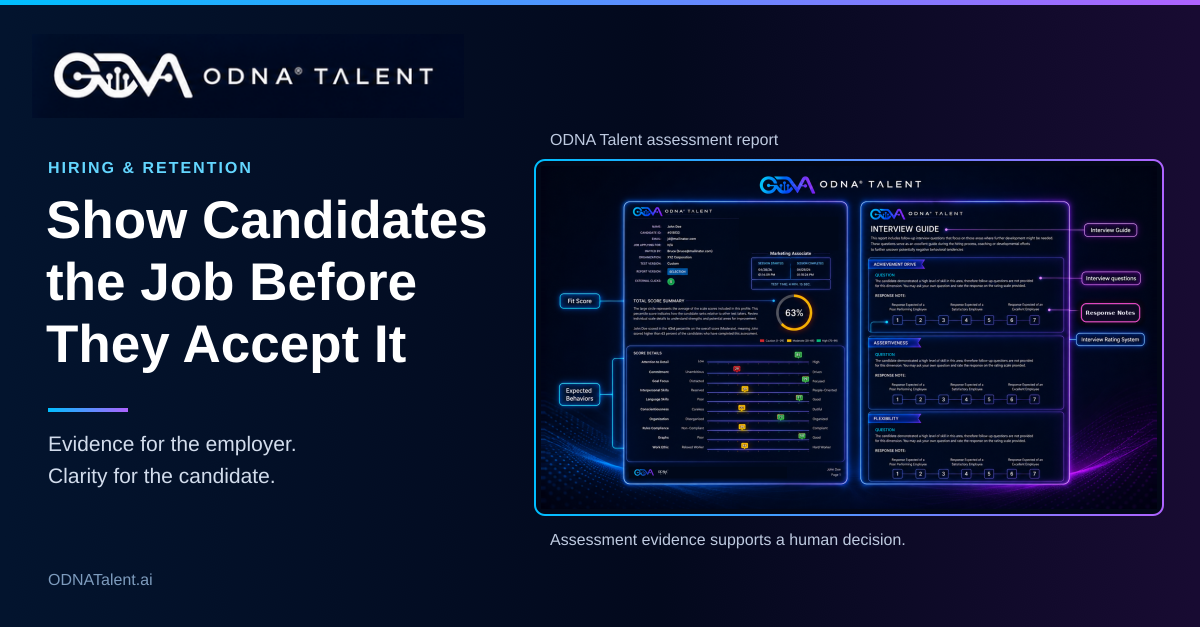
ODNA® Talent supports the assessment side of this process. Its current workflow allows an appropriate pre-built assessment or a role-specific configuration. For a role-specific assessment, documented job requirements, manager input, company criteria, and the optional ODNA® Role Blueprint inform Assessment Architect Mode's recommendations. An authorized person reviews and approves the configuration before delivery. [4]
The organization reviews results with interviews and other relevant evidence. It does not apply one fixed profile to every job or transfer the final employment decision to AI. [4]
The job preview described here is an employer practice, not a claimed ODNA Talent feature. The employer remains responsible for the accuracy of its job information and commitments.
Measure accuracy, not just acceptance
My suggested review measures are straightforward: unresolved candidate questions, changes communicated before start, first-day nonattendance, early voluntary departures, and reported differences between the promised and actual work.
Review those measures together. An acceptance rate alone cannot tell you whether candidates understood the position. A decline after clarification deserves examination, not an automatic conclusion that the recruiter failed.
Do not claim that a preview or assessment caused a retention change. Review pay, scheduling, supervision, training, and operating conditions as well.
Before the next offer, ask the hiring manager one question: what might this person discover on the first week that we should explain now?
Then give the candidate the answer.
Hiring & Retention
Practical takeaways
- Check whether recruiting messages and actual commitments agree.
- Explain uncertainty instead of making an informal promise.
- Separate a job preview from a scored work sample.
- Use assessment evidence and candidate understanding for their different purposes.
- Review discrepancies after the start date and correct the source.
Sources and useful ODNA Talent links
- 1. National Retail Federation, October 15, 2026: Holiday Sales Forecast
- 2. U.S. Office of Personnel Management: Realistic Job Previews
- 3. John P. Beck, Jr.: Turn Job-Specific Assessments Into Better Structured Interviews, July 19, 2026
- 4. ODNA Talent: How It Works
- Job-Relevant Assessments
- Structured Interviewing
Educational information only. Organizations remain responsible for obtaining appropriate legal, scientific, privacy, accessibility, and professional guidance.