
I have watched hiring managers conduct enough interviews to know that a comfortable conversation can still produce a weak decision. Unstructured interviews feel natural, but they can drift toward different questions, different standards, and different opportunities for each candidate. A structured interview creates a more consistent foundation.
The U.S. Office of Personnel Management defines a structured interview as an assessment method that measures job-related competencies through standardized questioning and scoring. Pairing that discipline with a job-specific assessment can make follow-up more focused—if interviewers avoid using the report as a predetermined conclusion.
Begin with the same core questions
Candidates competing for the same role should generally have a consistent opportunity to address the same core competencies. Questions should connect to the work and invite evidence: what the candidate did, why they chose that approach, what happened, and what they learned.
Defined rating anchors help interviewers evaluate the quality and relevance of the response instead of relying on memory, chemistry, or a general impression.
Use assessment results to focus—not bias—the conversation
A report may identify a behavior, judgment factor, or skill that deserves closer exploration. That can inform a follow-up question, but the interviewer should not assume the score tells the complete story. The candidate's explanation may add context, reveal compensating experience, or challenge the initial interpretation.
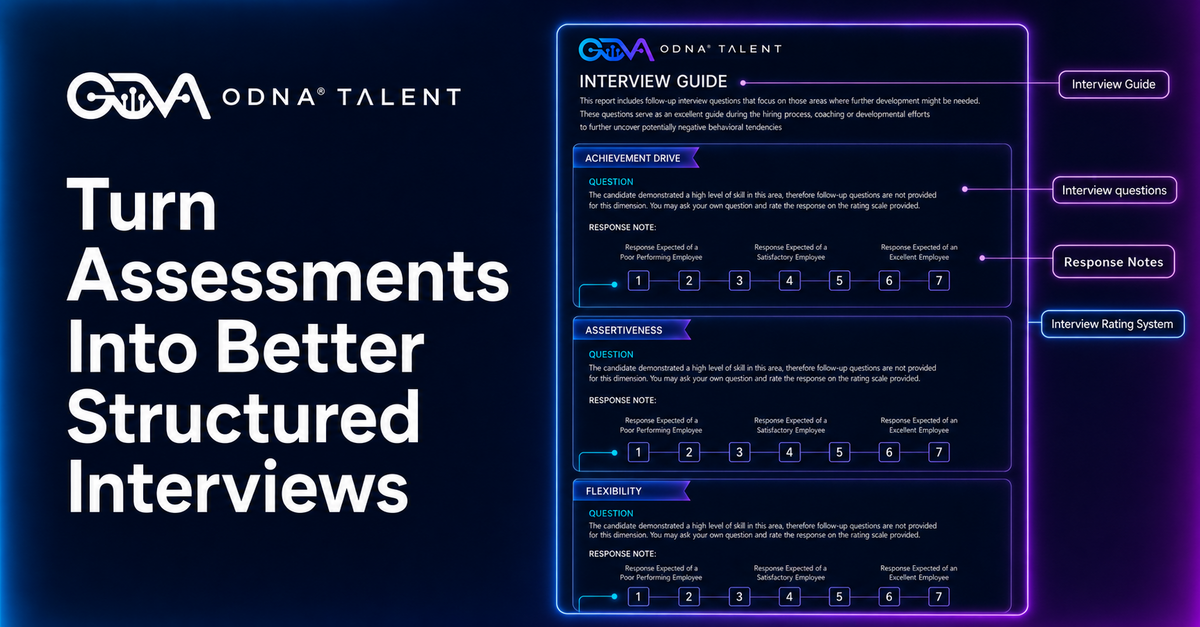
This is where expected behaviors and response notes become useful. They translate an abstract result into observable, job-related evidence and give the interviewer a consistent place to capture what was actually said. In plain English: do not interview the score. Interview the person and document the evidence.
- Ask the same core questions for the role.
- Use assessment-informed probes only where they are relevant.
- Record evidence and examples instead of labels or impressions.
- Apply a defined rating system consistently.
Keep the assessment and interview in the same decision framework
When the assessment was built around the role, its interview guidance can trace back to the same requirements. That creates a connected process from job definition to measurement to human conversation.
No single source should carry the entire decision. The value comes from convergence: role evidence, assessment results, structured responses, relevant experience, references, and other appropriate information reviewed together by accountable people.
For the hiring team
Improve the interview, not just the report
- Use consistent core questions and scoring criteria for the same role.
- Treat assessment results as areas to explore, not conclusions to confirm.
- Capture job-related evidence in response notes.
- Review assessment and interview evidence together with the broader decision context.
Interview standards and related tools
John P. Beck, Jr., Breaking the Code: Hiring Strategies, Occupational DNA®, & the Modern Organization, Chapter 1, “We Hire on Skill & Fire on Fit,” pp. 25–26.
- U.S. Office of Personnel Management: Structured Interviews
- ODNA Talent: Structured Interviewing Guide
- ODNA Talent: Interview Guide
Educational information only. Organizations remain responsible for obtaining appropriate legal, scientific, privacy, accessibility, and professional guidance.