
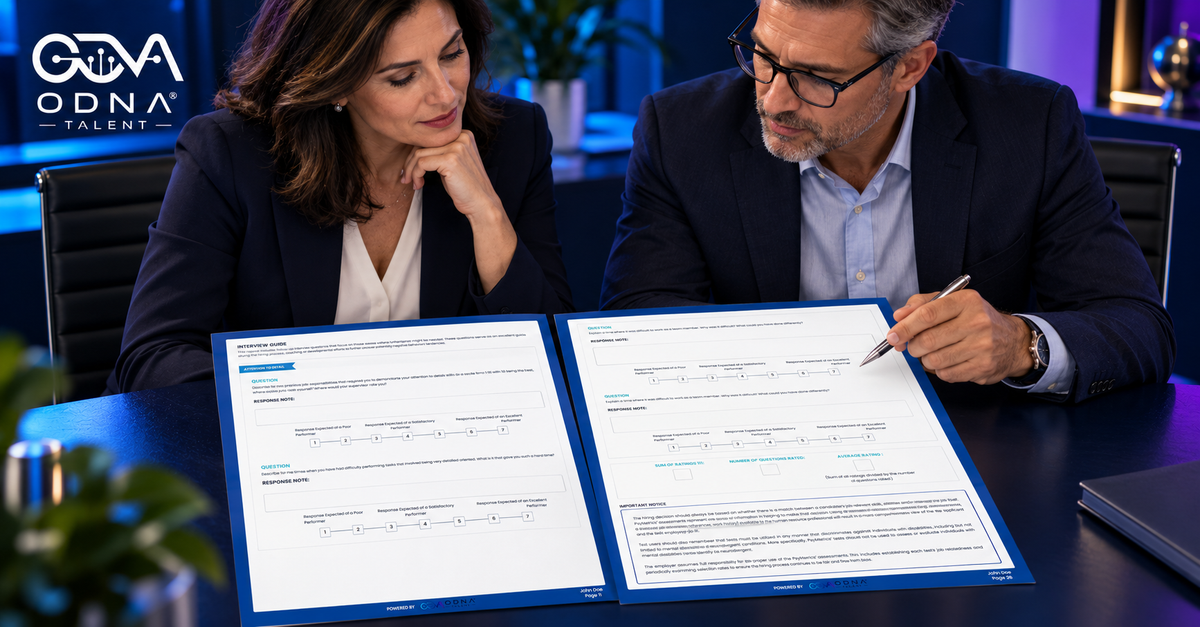
A hiring assessment should give an employer useful evidence about the work. That starts with a basic question: can the candidate access the instructions and complete the process in an appropriate format?
October is National Disability Employment Awareness Month. The U.S. Department of Labor's 2026 theme is “Celebrating Value and Talent.” Its employer guidance includes reviewing policies and training supervisors. The Postal Service also highlighted the observance in an October 5 announcement. [1, 2]
My recommendation is to use this month to review one actual hiring process. Follow the invitation, instructions, assessment, and follow-up from the candidate's perspective. Find out who handles a request for assistance and how the hiring team knows when the issue has been resolved.
Start with the requirement being measured
Write down the capability each selection step is intended to evaluate. Customer problem-solving, written accuracy, equipment knowledge, and time-sensitive decisions are different requirements. Each needs an appropriate way to demonstrate it.
Then examine the delivery conditions. Is speed part of the intended measurement? Is listening being assessed, or are spoken instructions simply explaining how to begin? The answer affects what a qualified reviewer should consider when a candidate requests an adjustment.
EEOC guidance explains that test administration should reflect the intended skill or aptitude rather than a disability-related limitation. It also addresses reasonable accommodations in testing, subject to the applicable requirements and undue-hardship standard. [3]
Treat that as a reason to examine the assessment's purpose and administration together. Do not improvise a change to timing, content, or scoring and assume the result means the same thing.
Make the process clear before it starts
Tell candidates what the hiring process involves and how to contact the person responsible for accommodation requests. Make that contact easy to find in the invitation.
The EEOC says an employer may describe the hiring process to all applicants and ask whether they need an accommodation for that process. That is different from asking everyone whether they need an accommodation to do the job. Pre-offer disability inquiries are generally restricted. [4]
For a manager, the practical task is straightforward: know where to direct the request. Use the authorized HR process for any necessary documentation. Keep medical details out of routine candidate-comparison notes and handle them through the appropriate confidential process. [4]
A practical example: instructions for a written exercise
Consider a hypothetical employer hiring an email customer-support coordinator. Finalists complete a written exercise about responding to a customer complaint. The purpose is to review written judgment and the application of a stated service policy.
The instructions are delivered only through spoken audio. A candidate who is deaf requests written instructions.
The employer should have its authorized reviewer examine that request with the candidate and assessment provider. In this example, understanding spoken instructions is not the skill the exercise is intended to measure. A written version of those instructions is an option to evaluate. The review should preserve the task and intended measurement. [3, 4]
This is an illustrative situation, not a client story. It contains no hiring result or performance claim. It shows why the delivery format deserves review before the employer draws a conclusion about capability.
A five-step review to use this week
1. Choose one active role. Identify the work outcomes and entry requirements that the hiring process needs to evaluate. Include the decisions that affect customers, quality, or safety.
2. Map the candidate's steps. List the invitation, instructions, assessment, work sample, interview, and support contact. Assign an owner to each step. Check whether that person knows how to escalate an access problem.
3. Confirm the assessment's purpose. Ask the provider what each measure evaluates and which administration conditions matter to interpretation. Have qualified people review proposed adjustments for the specific assessment.
4. Resolve reported barriers before relying on the affected evidence. An incomplete session needs investigation. Record what happened, what was reviewed, and whether the resulting information can be used. Do not turn an unresolved access problem into a conclusion about motivation.
5. Review recurring process problems. Track response time, unresolved requests, interrupted sessions, and repeated instruction problems through an appropriate confidential process. Use those measures to improve administration. They do not, by themselves, establish hiring quality or prove legal compliance.
Build ODNA Talent's assessment from the role
ODNA® Talent starts with documented job requirements. The ODNA Role Blueprint captures the role's outcomes, responsibilities, decisions, and demands. Assessment Architect Mode uses that information to recommend relevant measures and explain the proposed direction. Authorized people review and approve the assessment before delivery. [5]
That is a role-specific process. One fixed profile does not fit every job.
An accessibility review is a separate part of responsible administration. Confirm the available format and accommodation arrangements for the particular assessment. Do not assume that a role-specific design automatically establishes accessibility or that every configuration supports the same adjustments.
After assessment, people still need to examine the evidence. As I wrote in ODNA Talent's article on structured interviewing:
“do not interview the score. Interview the person and document the evidence.”John P. Beck, Jr. [6]
When an administration problem is reported, document its effect on the evidence before the manager relies on that evidence. Keep the employment decision with authorized people.
Keep the review practical
Start with one role and one assessment invitation. Confirm the job requirement, the measurement purpose, the support contact, and the review process. Then check whether managers know what to do when a candidate reports a barrier.
A clear process gives the team a better basis for evaluating the information it receives. The candidate still needs to demonstrate the role's requirements. The employer needs to know that its assessment process gave the candidate an appropriate opportunity to do so.
For a specific accommodation decision, involve qualified HR, assessment, and legal advisers as appropriate. This article provides general process guidance, not a determination for an individual case.
Assessment Practice
Practical takeaways
- Document the job requirement and the purpose of each assessment step.
- Make the accommodation contact visible before the process begins.
- Have qualified people review changes that could affect measurement or interpretation.
- Investigate reported access problems before relying on affected results.
- Track administration problems without claiming that process metrics prove hiring outcomes.
Sources and useful ODNA Talent links
- 1. U.S. Department of Labor, Office of Disability Employment Policy: National Disability Employment Awareness Month, 2026.
- 2. U.S. Postal Service: “October is National Disability Employment Awareness Month,” October 5, 2026.
- 3. EEOC: Employment Tests and Selection Procedures, issued December 1, 2007.
- 4. EEOC: Job Applicants and the ADA, issued October 7, 2003.
- 5. ODNA Talent: How It Works.
- 6. John P. Beck, Jr.: Turn Job-Specific Assessments Into Better Structured Interviews, July 19, 2026.
- Job-relevant assessments
All sources were reviewed on October 6, 2026. The October observance is the timely reason for this article. The EEOC materials are existing guidance, not newly issued rules.