AI is becoming part of recruiting and talent workflows at a pace that is faster than most organizations can update their policies. LinkedIn's Future of Recruiting research found that 73% of talent acquisition professionals expected AI to change how organizations hire, while 37% were already experimenting with or integrating generative AI.
I have spent my career helping organizations replace guesswork with better evidence. AI can help us do that faster, but faster is not automatically better. The useful question is where AI should help, where it should stop, and who will review what it produces.
Start with the task—not the technology
AI can be useful for organizing job information, identifying themes in a job description, suggesting relevant assessment scales, summarizing report content, or drafting structured follow-up questions. These are support tasks. They help a qualified user work through information more efficiently. That is how I believe AI earns its place in a talent process.
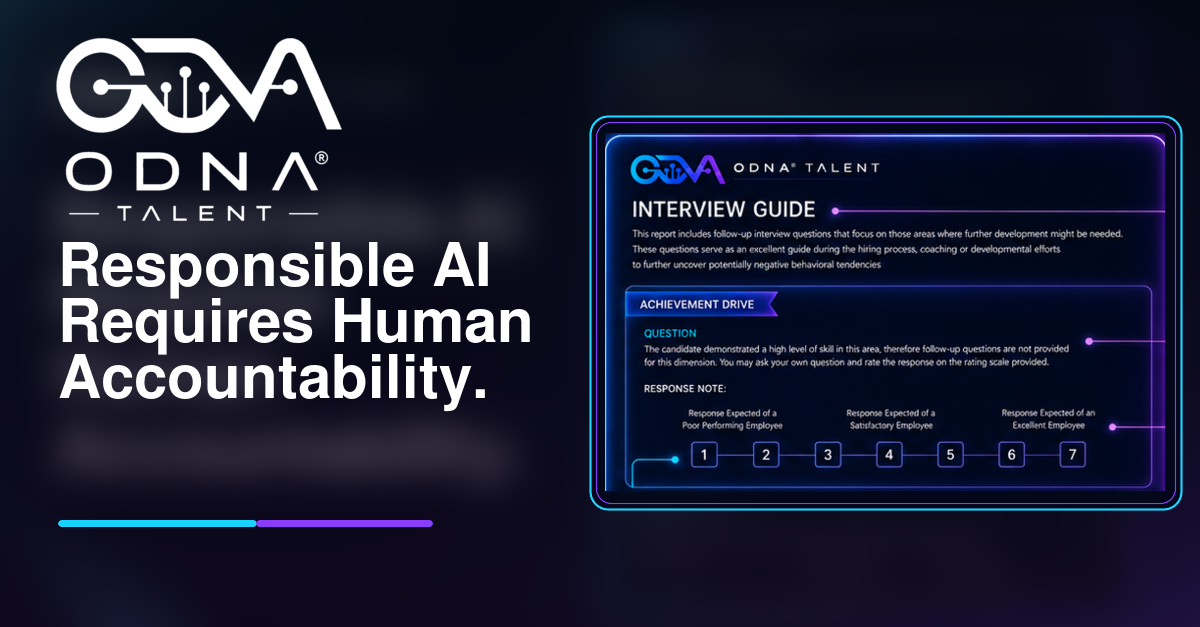
They are different from allowing a model to make a final hiring, promotion, termination, compensation, or other consequential workforce decision. ODNA Talent keeps that line explicit: ask ODNA supports the workflow, while the organization and its authorized decision-makers remain responsible for the outcome.
Responsible use needs a reviewable chain of reasoning
An AI recommendation is more useful when a person can understand what information informed it, how it relates to the job, and what must be reviewed before acting. A scale suggestion, for example, should connect to defined role requirements instead of appearing as an unexplained output.
NIST's AI Risk Management Framework emphasizes managing risk throughout the design, development, use, and evaluation of AI systems. In a talent context, that means governance cannot be reduced to a disclaimer at the bottom of a page. It should show up in roles, review steps, documentation, monitoring, and escalation paths.
- Define the intended task and the decisions AI is not permitted to make.
- Use job-relevant inputs and give users enough context to review recommendations.
- Train authorized users to check accuracy, omissions, and inappropriate assumptions.
- Preserve a practical path for questions, correction, and human follow-up.
Fairness and accessibility remain organizational responsibilities
The U.S. Equal Employment Opportunity Commission has warned that software and AI tools used in employment can create discrimination risks, including risks for applicants and employees with disabilities. Technology does not transfer an employer's responsibility to use an appropriate, job-related process.
Organizations should involve qualified legal, HR, assessment, privacy, accessibility, and technical professionals as appropriate. This article provides general educational guidance, not legal advice. The larger principle is durable: responsible AI should make human review stronger, not make accountability harder to locate.
Operating rules
Keep accountable people in the process
- Use AI for defined support tasks rather than final workforce decisions.
- Require users to review AI output before it enters a consequential process.
- Connect recommendations to role evidence and intended use.
- Treat fairness, accessibility, privacy, and governance as operating practices—not marketing language.
Standards and guidance used here
- NIST: AI Risk Management Framework
- EEOC and DOJ: AI tools and disability discrimination
- LinkedIn: Future of Recruiting 2025
- ODNA Talent: Responsible AI
Educational information only. Organizations remain responsible for obtaining appropriate legal, scientific, privacy, accessibility, and professional guidance.