Yes, personality fit can outweigh a trainable skills gap.
A person can learn software, product knowledge, procedures, and technical skills. Experience can be gained. What an employer cannot reliably train into someone is natural alignment with a role that consistently demands a different way of thinking, working, communicating, or responding.
That distinction matters because the cost of a bad hire is rarely limited to a missing skill. The larger cost often comes from putting a capable person into work that does not fit how they are naturally wired to perform.
A recent Express Employment Professionals and Harris Poll survey confirms that hiring managers recognize this. The survey found that 91% of U.S. hiring managers believe personality matters as much as skills. Another 86% said personality can outweigh a candidate's skills gap. The survey included 1,006 U.S. hiring decision-makers and was published on August 26, 2026.
After 31 years in employee assessment, I agree with the central finding. Employers should give personality fit serious weight. The mistake is not valuing fit too much. The mistake is trying to judge it without first defining the job and measuring the characteristics that matter.
“Skills can be taught. Experience can be gained. A persistent mismatch with the role is harder and more expensive to correct.”John P. Beck, Jr.
Skills show what someone can do today. Fit helps show how they will approach the work.
A resume records exposure. It does not prove natural fit.
A candidate may have five years of industry experience and still struggle with the pace, decisions, accountability, customer contact, rules, or problem solving the new role requires. Another candidate may have less direct experience but bring the behavioral alignment, motivation, learning capacity, and work discipline needed to grow into the position.
Consider three common examples.
- A sales candidate can learn a CRM and product line. Training is less likely to create a sustained drive to prospect, recover from rejection, and persuade others if those demands do not fit the person.
- A production employee can learn a process. Training is less likely to correct a lasting mismatch with precision, rule adherence, pace, or personal responsibility.
- A customer service employee can learn policies and product details. Training cannot be relied upon to create patience, service orientation, emotional control, or a genuine interest in helping people.
- This does not mean personality is fixed or that people cannot adapt. People learn and develop throughout their careers. It means employers should not build a hiring decision on the hope that training will erase a fundamental mismatch between the person and the work.
What does personality fit mean in hiring?
Personality fit is not whether an interviewer likes a candidate. It is not whether the candidate resembles the current team. It is not a universal profile of a good employee.
Job-specific personality fit is the degree to which a person's natural behavioral tendencies, interests, motivators, work preferences, and related characteristics align with the actual demands of a particular role.
The job determines what matters.
The U.S. Office of Personnel Management states that the personality factors most predictive of performance depend on the job. It also explains that performance is usually better understood through a combination of relevant personality scales instead of one isolated dimension.
That is why a generic personality label is not enough. A trait that supports performance in one role may add little value in another. The measurement must follow the job.
When should personality fit outweigh a skills gap?
Personality fit should carry more weight when the missing skills or experience can be developed within an acceptable time, cost, and level of risk.
The practical decision is to separate entry requirements from trainable requirements.
Entry requirements must be present before the person starts. These may include a required license, certification, safety qualification, technical foundation, or knowledge that the organization cannot reasonably provide after hire.
Trainable requirements can be developed through onboarding, coaching, supervised practice, or experience. These may include a company system, internal process, product knowledge, or industry terminology.
OPM makes a similar distinction in its guidance on job knowledge testing. It states that job knowledge tests are not appropriate when applicants will be trained after selection in the critical knowledge areas. It also notes that job knowledge testing is most useful when specific knowledge is required on the first day.
The employer's question should be clear: Can we close this person's skills or experience gap faster and at a lower cost than we could manage a persistent mismatch with the role? In many cases, the answer is yes.
Hiring managers already judge personality. ODNA Talent makes the decision more job specific.
The same Express and Harris Poll survey found that 87% of hiring managers believe they can tell from the first conversation whether a candidate will succeed at the company. It also found that 61% use informal interactions, such as small talk, email tone, or treatment of administrative staff, to evaluate personality.
Those observations may raise useful questions. They should not be the only evidence.
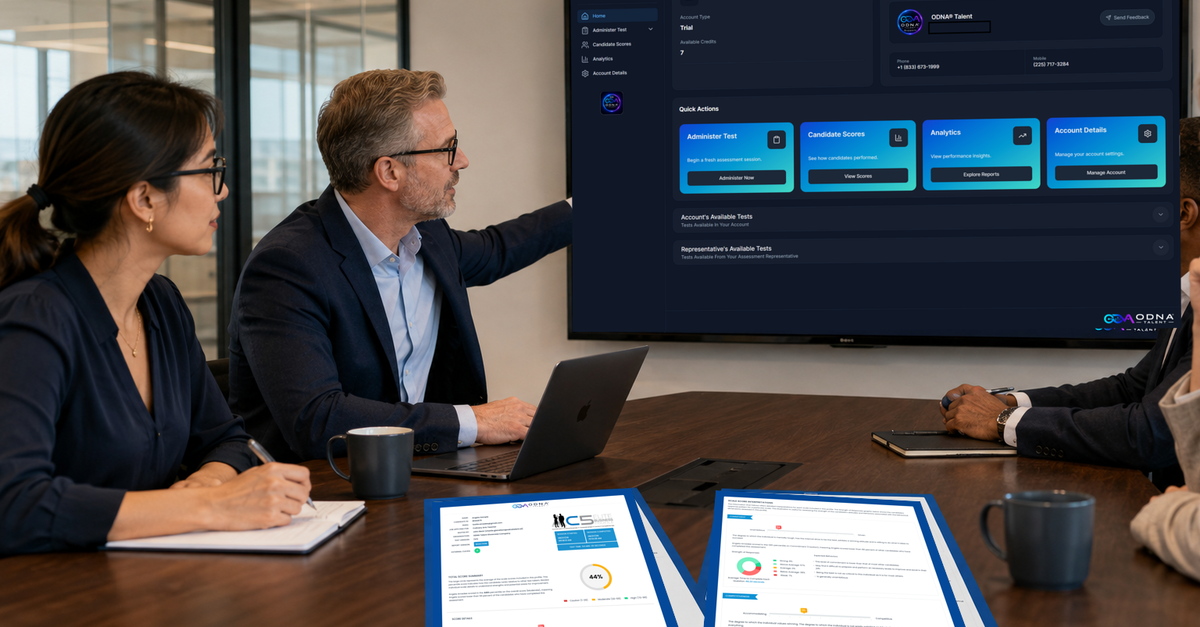
ODNA® Talent gives employers a more disciplined way to define and evaluate fit. It starts with the role, not the candidate and not a generic assessment.
The approved process is: ODNA® Role Blueprint (ORB) → Assessment Architect Mode → Human Review and Approval → Assessment Delivery → Report Analysis Mode → Human Decision.
The ODNA® Role Blueprint identifies the outcomes, responsibilities, decisions, reasoning and learning demands, behaviors, interests, motivators, integrity factors, and performance risks connected to the position.
Assessment Architect Mode can then recommend a focused combination from 200+ validated scales and explain why each measure fits the role. An authorized person reviews, edits, and approves the configuration before delivery.
After the assessment, Report Analysis Mode can help users work with the Fit Score, Expected Behaviors, Interview Guide, Response Notes, Interview Rating System, comparisons, and development guidance. The information helps the employer examine fit consistently and ask better follow-up questions.
A stronger personality-fit decision follows six steps
A disciplined process protects the importance of personality fit by tying every judgment to the role.
- Define the job before evaluating the person. Clarify the role's outcomes, work conditions, decisions, risks, and day-to-day demands.
- Separate required entry qualifications from trainable skills. Do not reject potential because a resume lacks something the organization already knows how to teach.
- Identify the behaviors, interests, motivators, and work preferences connected to performance. Avoid generic ideals and broad labels.
- Measure the focused set of characteristics that the role requires. Use job-relevant, validated measures and consistent administration.
- Use the results to improve the interview. Confirm strengths, investigate gaps, and ask the same core job-related questions across candidates.
- Make a documented human decision. Combine assessment evidence with experience, interviews, references, work evidence, and other appropriate job-related information.
Structured interviews confirm and add context to assessment evidence
Structured interviewing adds useful confirmation. OPM reports that interviews with greater structure show higher validity, rater reliability, rater agreement, and less adverse impact.
The structured interview does not reduce the importance of the assessment. It turns the assessment evidence into focused questions and gives the hiring team a consistent way to confirm what the report identified.
Employment assessments should remain job-related, consistently administered, and appropriate for their intended purpose. The U.S. Equal Employment Opportunity Commission states that employers remain responsible for ensuring their selection procedures are properly validated for the positions and purposes for which they are used.
The financial decision is straightforward
Assume an organization makes 40 hires each year. Six leave early or fail to reach acceptable performance. If recruiting, onboarding, training, overtime, management time, and lost productivity average $15,000 per failed hire, the annual exposure is $90,000.
If a more job-specific hiring process prevents only two of those failures, the estimated savings is $30,000.
This is sample math, not a promised result. Employers should replace the assumptions with their own hiring volume, turnover, time to productivity, and replacement costs. The ODNA Talent Turnover Cost Calculator can help establish that baseline.
Personality fit deserves more weight, not less
Employers should not lower their standards to hire for personality. They should improve their standards by defining what the job requires and separating what can be learned from what must naturally align.
Skills can be taught. Experience can be gained. A persistent mismatch with the role is harder and more expensive to correct.
That is the value of job-specific personality fit. It helps an employer see beyond the resume, identify potential, and avoid hiring someone into work that is unlikely to fit them.
Start with the role. Measure what matters. Develop the skills that can be taught. Then let an authorized person make the final decision using better evidence.
ODNA Talent assessments support employment decisions. They are not diagnoses, guarantees of performance, or replacements for job analysis, appropriate validation, structured interviews, legal review, or human judgment.
For the hiring team
Protect the fit. Develop the skills.
- Give job-specific personality fit serious weight when skills or experience can be developed.
- Separate day-one entry requirements from trainable gaps before screening candidates.
- Define fit against the role, not interviewer likeability or team sameness.
- Use the ODNA Role Blueprint and focused measures from 200+ validated scales.
- Use structured interviews to confirm and add context to assessment evidence.
- Keep assessment approval and the final employment decision with authorized people.
Research and guidance behind the recommendation
- Express Employment Professionals and The Harris Poll: Personality can overcome skills gaps
- U.S. Office of Personnel Management: Personality Tests
- U.S. Office of Personnel Management: Job Knowledge Tests
- U.S. Office of Personnel Management: Structured Interviews
- U.S. Equal Employment Opportunity Commission: Employment Tests and Selection Procedures
- ODNA Talent: How It Works
- ODNA Talent: ask ODNA
- ODNA Talent: Job-Relevant Assessments
- ODNA Talent: Structured Interviewing
- ODNA Talent: Turnover Cost Calculator
Educational information only. Organizations remain responsible for obtaining appropriate legal, scientific, privacy, accessibility, and professional guidance.