
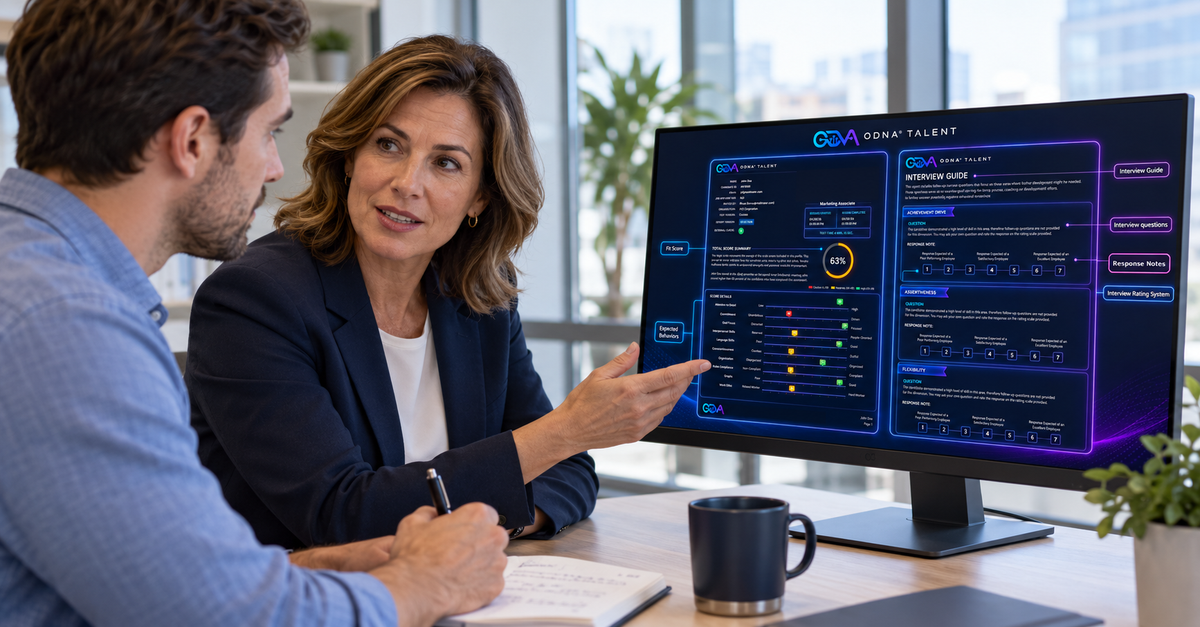
You assessed the candidate. You reviewed the results, asked better questions, and made the hire.
Then the report went into a file.
That is where useful information can get lost. The manager responsible for the new employee’s performance may receive a start date, a job description, and a training checklist. The insight that helped the organization make the hiring decision never becomes part of the onboarding conversation.
The assessment has already helped answer, “How does this person fit the role?” It can also help answer, “What should we pay attention to as this person gets started?”
“A hiring assessment should help you make the decision and help the manager know what to do after the decision.”John P. Beck, Jr.
A strong fit still deserves a thoughtful start
Selecting someone whose behavioral tendencies, interests, and abilities align with the role gives the manager useful information to work with. That person still needs clear expectations, relevant training, feedback, and an understanding of how the organization operates.
Consider two people hired for the same sales position. Both may be well suited to the work. One may readily initiate conversations but benefit from an explicit routine for documenting commitments. Another may prepare thoroughly but need coaching on when to move from research to direct outreach.
These are illustrative examples, not conclusions about any particular assessment result. The point is practical: the performance standard can remain consistent while the manager adjusts the support.
Training should address knowledge and skill gaps. Coaching can help people recognize their tendencies and develop practical routines. Neither should be treated as a way to turn a poor role fit into a different person.
This is where Report Analysis Mode comes in
Within ODNA® Talent, ask ODNA’s Report Analysis Mode helps users work with assessment results after the report is ready. Its capabilities include reviewing Fit Scores and Expected Behaviors, preparing summaries, and creating development and onboarding guidance.
For the manager, that creates an opportunity to connect the report to the work ahead.
What strengths should the employee have an early opportunity to use? Which job demands deserve a clear conversation? What support should the manager provide? What should both people review after the first month?
A practical request to use with Report Analysis Mode is:
“Using this assessment report and the role requirements, suggest three onboarding priorities. For each priority, propose a manager action, an employee action, and an observable measure of progress. Separate report findings from assumptions and identify questions that require a conversation.”
The manager reviews the guidance, checks it against the actual job, and agrees on priorities with the employee. AI-supported guidance remains subject to human review and approval.
Make the plan specific enough to use
“Improve communication” is too vague to guide a new employee.
“Confirm the customer’s next step, owner, and deadline before ending each handoff” gives the employee something concrete to practice. The manager can review examples and provide useful feedback.
The same principle applies across roles. Connect each development priority to an action, a work requirement, and a review date. Keep the initial plan focused enough that the manager and employee can actually follow it.
As work experience accumulates, use observed performance and employee feedback to refine the plan. Expected Behaviors provide a starting point for discussion. They are not a record of what the employee has actually done.
Measure the value after hiring
Track outcomes that matter in the position: time to independent work, quality, rework, customer follow-through, or another clearly defined performance measure.
For illustration, suppose a team hires 12 people annually. If a more focused onboarding approach reduced manager support by four hours per hire, at an assumed loaded manager cost of $75 per hour, that would represent $3,600 in manager time.
That is planning math, not a promised ODNA result. The organization would need to measure the change and account for the time spent preparing and reviewing the plans.
The next step is straightforward. Take one role, one authorized assessment report, and the expectations for the employee’s first 30 days. Use Report Analysis Mode to prepare guidance the manager can review and put into practice.
The report helped inform the hire. Keep using the relevant insight as the work begins.
After the hiring decision
Keep using the relevant insight.
- Carry relevant assessment findings into the onboarding conversation.
- Use Report Analysis Mode to suggest focused priorities and practical actions.
- Have the manager review the guidance and agree on priorities with the employee.
- Refine the plan using observed performance and employee feedback.
- Measure role-specific progress and the time required to support it.
Explore onboarding and report guidance
- Explore Report Analysis Mode
- ODNA Talent: Assessment-Based Development Planning
- ODNA Talent: Expected Behaviors Reporting
- Request an ODNA Talent demonstration
Educational information only. Organizations remain responsible for obtaining appropriate legal, scientific, privacy, accessibility, and professional guidance.